What It's About: A group of students investigates a series of mysterious bear killings, but learns that there are much more dangerous things going on. They start to follow a mysterious hunter, learning that he is actually a troll hunter.
Review: When I think of trolls, I typically am reminded of the Three Billy Goats Gruff; you know, the weird looking creature living under the bridge who threatens to eat the goats as they pass, but is eventually tricked out of his meal. Trolls definitely have a reputation of being one of the less pretty creatures in mythology, but they usually fall into the category of faeries who like to talk and bargain their way out of anything. Trollhunter knocks all of these usual expectations out of the ballpark, and is a really inventive use of the shaky came trick that's so damned popular right now.
In a market saturated with supernatural romance novels (Barnes & Nobles has an entire section devoted to the teenage version of this), it's nice to see something that doesn't quite fit the mold. Martin Millar's Lonely Werewolf Girl fits into that category - I actually found it in the Horror section before Borders went belly up, so maybe it just missed being shoehorned into the previously mentioned section.
Though the book is titled after only one character, there's actually a very wide cast. The 'main character' is Kalix MacRinnalch, a werewolf born on the night of the full moon. As with most female main characters in a paranormal setting, due to the circumstances of her birth, she's special. Kalix is a berzerker, a werewolf who can harness her rage into intense and powerful battle skills. However, the downside is that she can't control it, and in the environment that she's raised (distant, cold mother and a physically abusive father), it makes for a volatile mix. She is the youngest daughter of the Thane of the MacRinnalch clan, the current leader, and as such there are dozens of rules and expectations forced on her from birth.
The story picks up as Kalix has fled Scotland due to having attacked her father in a rage and put him on his deathbed. Kalix's brothers are gathering supporters in an election for who will be the next Thane; her sister, Thrix (a powerful werewolf enchantress), is busy trying to stay out of family politics and run her clothing design business while trying to figure out who is stealing her designs and cater to a meddlesome fire elemental; and then there are the humans, Daniel and Moonglow, who bring all of this insanity into their lives by helping Kalix out through giving her a place to stay.
What really sets this book apart from the usual fare is Millar's writing style. At first I found it incredibly flat and simplified, with very little description or elaboration. But it works for this story: since there's just so much going on, simplfying the writing style allows the reader to keep tabs on all of it. Because then there's Kalix's brother Markus, who's a cross dresser. And her banished boyfriend, Gwaine. Kalix's cousins, Beatix and Delix (yeah, there are a lot of Xtreme Kool Letterz at play here), who are wannabe rockstars and are eventually brought to heel by Dominil. And Dominil has a connection to Sarapen, Kalix's other brother. And all of that is just the werewolves: the fire elementals have their own issues, all of which eventually intermingle with the werewolf drama.
But that isn't to say that the writing doesn't have a poetry of its own. The book is full saturated with gory fighting scenes, and the simple writing allows for the reader to picture the image clearly in their mind, all with their own details to be added. It allows for interpretation and participation by the reader, which is never a bad thing. And watching the characters grow is fun in itself, along with seeing the completion of all of the plot lines. If you're looking for something that's different than Twilight, but not as heavy and potentially mentally scarrying as The Exorcist, I'd definitely reccommend Lonley Werewolf Girl.
In high school, anime and manga was the thing. It was so incredibly popular that our school even offered an art course that focused selectively on anime; the anime club was off its rocker in terms of membership; and to go along with the madness, the television pandered to our obsession with programming like Toonami, which had a listing of DBZ, Sailor Moon, and Gundam Wing. But all of this is beside the point - because the Asian comic book that I was head over heels for was a manhwa, a Korean comic book, that went by the simple name of Priest.
I will admit, I'm a sucker for anything with Guillermo's name on it. After The Devil's Backbone, Pan's Labryinth, The Orphanage, and, yes, even Hellboy 1 and 2, this man can do no wrong in my book. He seems to be a tireless source of creative ideas, and quite honestly does this opinion of him justice yet again with The Strain books. I'm still working my way through all of them, so we'll just concentrate on the first book to begin with.
It's a vampire book, yes, one of many amid an influx of the undead that's been injected recently into popular culture, but The Strain sets itself apart through sticking to the older rules of what it means to be a vampire while mixing it with science - it's kind of a modern Dracula.
The story follows a mysterious plane that lands in JFK airport - it simply comes down, sets on the tarmac, and then...nothing. Nothing from the passengers, nothing from the pilots; and so Dr. Ephraim Goodweather and his Canary team (a reference to coal miners, who would use the birds to detect poisonous gases that were otherwise invisible to human senses) to begin the process of figuring out just what happened here. Is it a virus? Some new form of plague? Slowly the truth becomes much, much darker and much less believable in the modern time that would rather shrug off the myths and fears of yesteryear as nothing more than simple minded folk who were making do with what explanations they had.
Sardu, the Dracula of our tale, is one of seven remaining immortals who have created a pact. They are to feed - and these vampires will suck you dry - but once they are done, they must destroy their prey for a new vampire will be born once a human is bit. A rather simple yet elegant solution to what could have easily turned into a massive overpopulation problem. But of course, Sardu is the renegade who believes that he can do what he wants, when he wants, and goes on to detonate a war between the immortals.
The Van Helsing role is filled by Professor Abraham Setrakian (yup, Abraham, couldn't make this any easier for you folks), who was hunted by Sardu as a young boy. What makes his story even more captivating is that he survived a concentration camp during World War II. Sardu could have easily been chalked up to being the twisted nightmares of an old man remembering the horrible days spent in a place that solely existed for the murdering of people. Instead, Sardu is indeed a true vampire, and Setrakian takes it upon himself to rid the earth of the monster. I do wish that more had been made of the parallels between the concentration camp and the vampires, but it's clear that this story was focusing on the turning reality into the supernatural.
The rest of our updated cast for The Strain includes Goodweather as Jonathan Harker, while his divorced wife Kelly takes up the role of Lucy Westenra (which definitely gives away what befalls her). Goodweather's other lady friend, Nora Martinez, could be said to be Mina, the huge Russian rat exterminator Vasiliy Fet is a good stand in for Dr. Steward what with his methodological killing of the vampires (along with his role as something of a son to Setrakian, not unlike the relationship between Van Helsing and Seward), and lastly, to fulfill the role of Quincey Morris, the hotheaded American cowboy, is Augustin Elizalde, a Mexican gangster who goes by the nickname of Gus.
In my mind, the parallels to Dracula are more than just the roles that the characters fulfill - the story itself speaks to the wonders of modern technology and how it can be used to overcome the fears of the past. The new inventions of the telegraph, which allowed people to communicate over vast distances, and the steam engine that gave the ability to transport people over hundreds of miles. These things and more are used to combat and work against the monster, who is trapped in the workings of the past (Dracula favors ships over steam engines, allowing the intrepid heroes to catch up and eventually slay him). In The Strain, ultraviolet lights and silver swords allow for both the protection of the living and the quick dispatching of the undead.
I'm sure these are only a few of the similarities between the two books, but I absolutely love what Hogan and Guillermo have done here. Not only have they given many nods to a classic work of fiction, but they've updated and remade it for modern times in the way that any remake should be done - not word for word (or frame for frame), but instead looked at from a different angle. I'm definitely excited to continue the series and see if the similarities hold up, and that the storytelling remains strong.
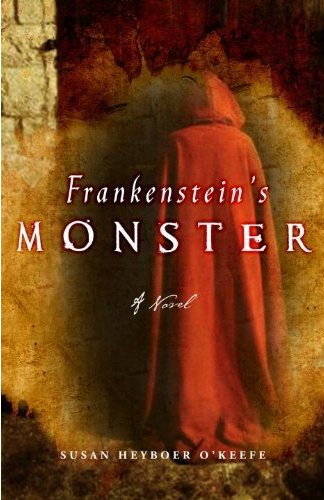
Frankenstein has been my favorite book for quite some time; it's a classic, as both a piece of literature and as the source for one of the most well known monsters in horror fims to date. So, naturally, the idea of a sequel is bound to polarize fans - how does one follow up on Mary Shelley's gorgeous story about man creating man in order to give any creator the middle finger, only to come to resent the decision and be plague for the rest of his days by his gruesome creature? Susan O'Keefe certainly found a way to make a stunning addition to the story, with florid but not overbearing prose and beautifully described characters that, in my mind, is definitely worthy of being put next to my copy of the original on my bookshelf.
Where the ending of the original had the creature running off to kill himself at the desolate North Pole, O'Keefe alters the story to have Robert Walton become obsessed with destroying the creature. He's come to the belief that he and Victor Frankenstein were something of kin, of two men with the same mind of exploration and discovery. Where Victor's career was biology and science, Robert is an adventurer exploring the arctic wastes of the North Pole. He feels beholden to Victor, and must right the dead man's wrongs: this includes completing the destruction of the creature.
Where the original story centers around Victor's perspective of the events, this sequel follows the creature (as is evidenced by the title); O'Keefe does a marvellous job of not simply painting the portrait of a sympathetic creature, but someone that I was conflicted in liking through both his actions and thoughts. The creature is a beast, though whether this is due to his creation and upbringing or through his psychological state is something that the reader themselves will have to decide.
A parade of characters joins the creature in this story, and none are more fascinating than O'Keefe's version of his bride. She remains true to the idea that Victor desecrated and destroyed the female he was creating, and in her place we receive two different characters that incredibly contrast one another. The first is the mute Mirabella, who is one of the few (if only) people to ever show the creature a shred of kindness for no perceptible reason. And then there is Lily, Robert Walton's niece, who is just as twisted and deformed in her mind as the creature is in body. The two make an antagonistic couple that seem to delight only in the torment of one another - Lily feeds into the creature's rage and salts his mental wounds, a fitting tormentor for the monster.
My only complaint against the book woud be in the creature adopting Victor's name; at least he didn't take the entirety and call himself Victor Frankenstein. Though I can see it being in the vein of children being named after their fathers, it irked me that while the creature wanted to be recognized as another living being and eventually grew to hate his 'father', that he would adopt Victor's name when pressured for something to call him by other than 'creature'. Or perhaps I'm just so used to seeing him named as such that it feels wrong to call him by the mad scientist's name.
Overall, this book is a welcome companion to Shelley's original; if you're a fan of Frankenstein: Or The Modern Prometheus, you will love biting into this beautifully written book. Or if you simply enjoy good literature, it's a fascinating read.