Monday, January 14, 2013

The Walking Dead game (2012)


I’m going to start this off by saying the creators of The Walking Dead game are bad people and they should feel bad. This is, of course, not to say that the game itself is bad – in fact, it’s fantastic. It’s incredibly moving and every turn will present you with another hard hitting question or decision that pushes you, as a survivor of the zombie apocalypse, to your very limits.

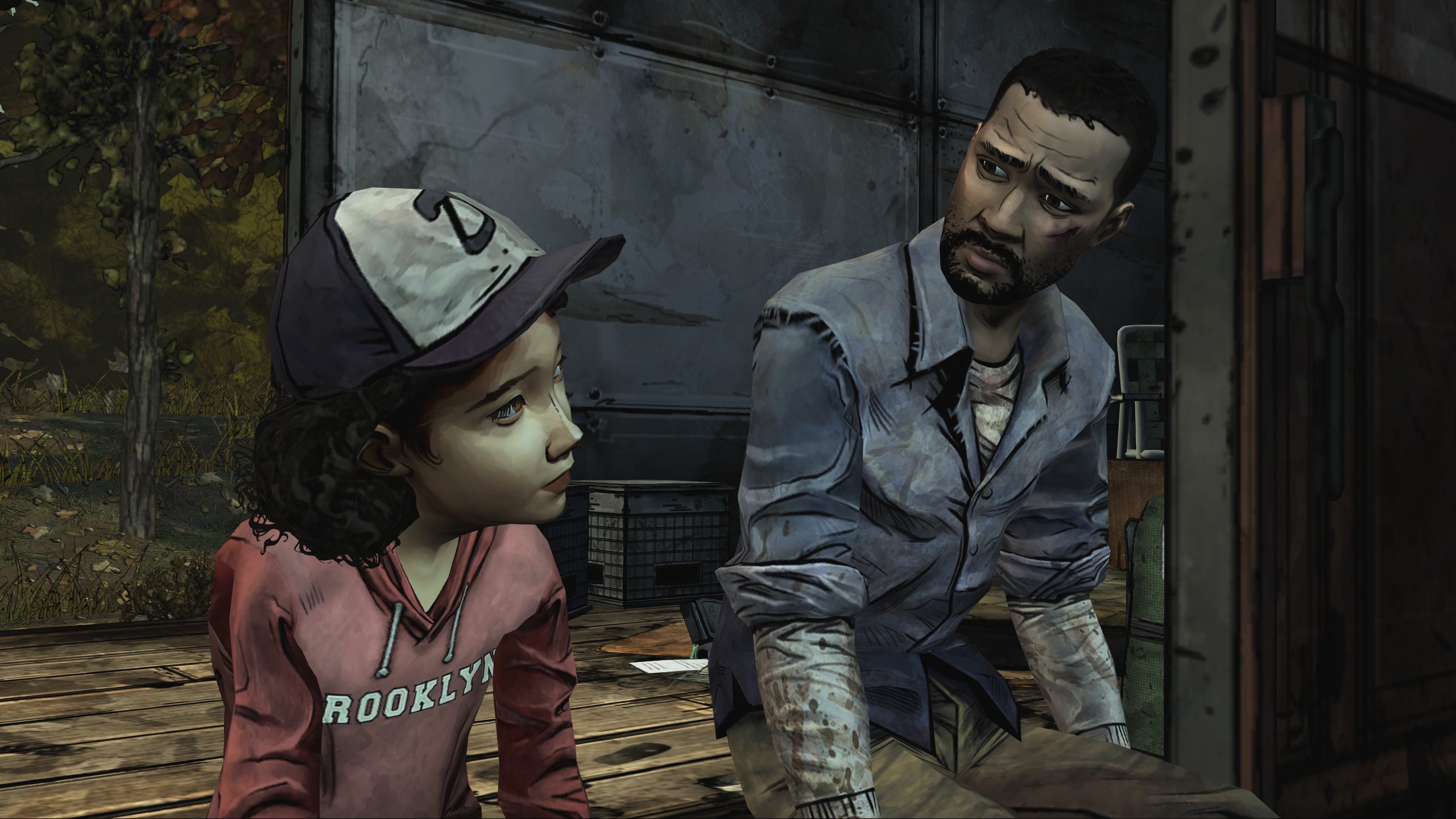
The Walking Dead game is a point and click game (with a few quick time events sprinkled throughout) developed by Telltale, the people who brought us Tales of Monkey Island. It tells the story of Lee, a man convicted of murder, and Clementine, an eight-year-old girl, as they try to survive through the beginning of the zombie apocalypse. The two are brought together by chance when the patrol car Lee is being transported in gets into an accident with a walker and Lee must fight to survive. He finds Clementine along the way – she’s hiding in her house, where she had been babysat while her parents were away in Savannah.

The entire game hinges on the decisions you, as the player, will make. Will you tell strangers about your past? Who's going to live and who's going to die? How are you going to keep everyone around you calm as more and more walkers continue to appear, hungering after your living flesh? Any and all actions have intense repercussions, and often in ways that you could never expect. The story itself is intensely gripping. Each character has their own story and will react in their own way to the decisions you make.

Thus, every time you play and make a decision differently, you alter the course of the game. Where one character might have died in your first play through, they could live in your second. Outcomes, punishments and justifications will all change as you move through the game in various ways. And, man, the storylines in the game do not pull any punches. Some characters that I at first hated I came to like, while others lost my respect due to different reactions. Sometimes it didn’t quite make sense, or I imagined something I had Lee say coming off in a different context, but I suppose that can be chalked up to the stress that everyone would be under in an apocalypse.


The entire game is presented in a comic-book style, where you can see lines and brush strokes coming off of the characters. This cartoony representation in no way diminishes the gore – in fact, it makes it almost worse. All of the characters are extremely expressive, with mobile faces and large eyes. What’s also neat is that there are a variety of body shapes – no stick-figure women and buff men are to be found here. Each character, even the walkers, seems separately molded to fit into a world of varied people. The walkers tend to look a little odd after a while, with skulls for faces, but in truth they’re only a small part of the game. But yes, varied people of different shapes and sizes! Varied races! The main character is not a know-it-all white guy!

I don’t want to spoil any of the chapters, because honestly they’re far more hard-hitting as you play through and discover the story along the way. Some things will be painfully obvious, hinted at with an unsubtle hand, but it’s all in the reveal. To offer you some kind of a measuring stick, the show doesn’t have anything on this game in terms of storytelling. The only thing I wished they’d done differently was make the puzzles harder. This game is pretty easy to get through with a lot of basic observation and exploring every nook and cranny. I suppose, then, the meat of the game is the story and its characters, and it in no way disappoints.

I just hope you get a better initial ending than I did.


Saturday, April 7, 2012

Saturday Horror Short #9

Relationships suck. Love sucks, and sometimes we do stupid things when we feel hurt. But sometimes, those emotions come from somewhere else, maybe even from something else. Love Hurts tackles that exact idea, in a gorgeous fashion that brings together some great elements of what a short horror film should have. Enjoy!


Friday, April 6, 2012

The Devil's Rejects (2005)


What it's about: A vengeful sheriff and two bounty hunters track a murderous family on the run.

Review: Distinctly different than House of 1000 Corpses in tone, we begin with a recounting of what we learned in the first movie - how the Firefly family led a life full of sadistic torture, rape, and murder within their dilapidated farmhouse in Alabama. Photos of the victims twisted in various forms are shown on the screen in startling relief. 

Change to the camera framing the top of a dead woman, completely nude we soon learn as the camera pans out to show Tiny Firefly dragging said corpse through the woods surrounding the farmhouse. We are unsure of his destination, but that information becomes obsolete as in the distance, the sound of police cars and the image of the cars and trucks race down the road towards the farmhouse with the obvious intent of arresting the family. 
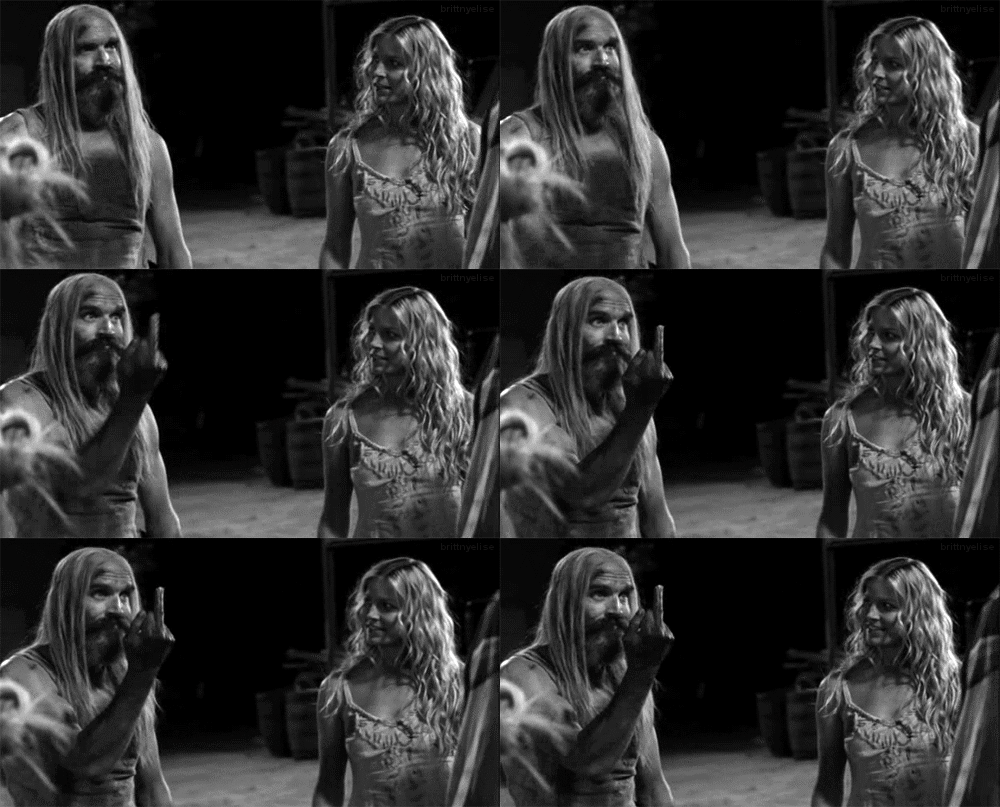
And this is what Otis had to say to that.


Wednesday, April 4, 2012

Sudden Death Overtime, Steve Vernon (2012)


Mr. Vernon is a pretty prolific novelette writer.  He's already got 11 titles under his belt, and the twelfth involves vampires and hockey; I know, an odd combination, but it's actually quite entertaining. The entire story is tongue-in-cheek, pages of camp that are designed to crack a smile if not out-rightly make you laugh out loud (I know I did).

The entire story takes place over a week in the small town of Hope's End, near Labrador, Canada, following a group of "old farts" as they contend with the stagnant pace of their lives, each carrying his own inner burden. The one thing that really brings them together is hockey, and they all care for a local rink that the town kids play on. 

It's basically their way of giving back to the community, in order to keep the teenagers in line and stop anyone from blowing a gasket. Small towns definitely have a way of causing bigger blow outs for smaller issues, so it's kind of these guys to do what could be seen as such a small gesture.

But the simplicity and mundane consistency of their lives is abruptly interrupted by the appearance of a devilish black bus. I really enjoyed the descriptions of the bus, how it comes alive and is literally an entity in its own right, never mind the cargo its hauling around. The vampires, using their dark vehicle, slowly begin to eat their way through the town populace, even going so far as to destroy the local church as a safeguard for their own protection. The group of old men are finally clued into the vampires after both the disappearance of one of their own along with a confrontation that brings the toothy predators right into their line of vision - as well as smell, since they end up using garlic to fend off their attackers.

Being the crotchety old codgers that they are, the men don't go down without a fight, using every book and movie trick that they've heard about in order to protect their beloved town from the undead menace. It all eventually culminates in a hockey game to the death, putting not only hockey sticks and skates to new uses, but the very rink itself.

Sudden Death Overtime is available on Amazon for $2.99 in digital format only.

Monday, April 2, 2012

The Casebook of Victor Frankenstein, Peter Ackroyd (2008)


This is another "rewrite" of Frankenstein that I found out about after hearing that it had been optioned to be made into a film. Like any and all things related to Shelley's classic, I rushed out and found a copy; I'm glad to say that I found it in hardback, making the cover art absolutely stunning and the page quality top-notch.  The writing is, of course, beautiful and well done, but the story itself left me with quite a few questions. Not that the plot is unfinished, or has undone tangents; simply the whole idea of it made me curious as to how it came about.

Of course ,Victor Frankenstein is our main character, as always, and this book tells his story (as per usual) from his first person point of view. We are first introduced to him when he's in school at Oxford, studying the human body to divine its secrets, even when the professors frown on these kind of shenanigans. More that needs to be known? They scoff, believing that God has already told them all they would need to know about the human form. Victor is not dissuaded from his course, and instead actually finds another companion who proves to encourage Victor's strange tendencies. This person is none other than Percy Bysshe Shelley himself, the Romantic poet that Mary Wollstonecraft Godwin (aka Mary Shelley) attached herself to.

Bysshe, as he insists Victor name him, is a volatile and manic fellow who throws his lot in with activists, always feeling that he is able to speak his mind in any group. Victor doesn't necessarily follow his lead, but becomes a member of Bysshe's entourage for the short time Bysshe is at Oxford. Victor's story follows the usual course - he becomes so enamored of the idea of creating life that he eventually researches galvanism and other forms of electrical inquiry, all toward the idea of reversing death. His experiments eventually work, but the creature (the only name for the thing) is so hideous and brutish that Victor relinquishes all ownership due to a creator.

The creature, of course, doesn't take kindly to being rejected so utterly, and thus a battle of wills is formed. It's simply not the battle of wills that one is used to - I certainly suspected something was amiss when the creature knew more than it should have, and the ending has a twist that I frankly did not see coming. This sort of story would certainly be wonderful to see in a thematic format, if it ever gets made; but my question was why did it seem necessary to introduce Percy Shelley, Lord Byron, Samuel Coleridge, John Polidori, and even eventually Mary Shelley herself into this narrative?

It's almost like that recent Dracula sequel, Dracula Undead, where Bram Stoker himself makes an appearance. It's nothing more than a gag to make readers interested; if anything, what it does, for me, is provide the theory that Mary did not necessarily come up with this story on her own, but that she based it on the life of someone she knew. Which I frankly find insulting, considering who Mary's parents were, the company she kept, and the times she lived in. I'm sure that Mr. Ackroyd did not intend to insult anyone, that he merely thought that this was a good twist on a well known story. And it is - the ending, for me, redeemed the rest of the book. It's definitely a good read, if simply to see the ending unfold. But I personally dislike this idea of introducing real literary people into fictions as though this adds something to them, when it clearly doesn't. 
Related Posts Plugin for WordPress, Blogger...