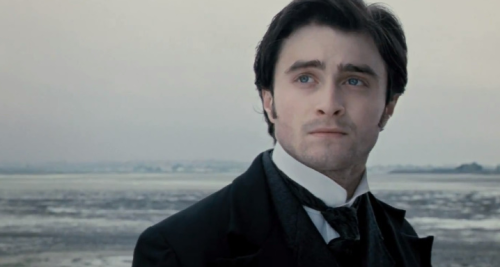
Gothic horror brings to mind Victorian period, where people were obsessed with death, what came after, and how to be sure that their loved ones were in a safer place. Queen Victoria's reign made the mourning period a culture - and thus a variety of ghost stories were born. Susan Hill's The Woman In Black continues this tradition, and the story carries such weight that it's been made into several different formats: a radio program, a theater play, and a british film. Most recently it was adapted by the newly reopened Hammer Studios for a theatrical film starring Daniel Radcliffe. Here I'll talk about the adaptation of book to film, and compare what works, and what doesn't. There will be some spoilers, as I'll have to cite specific scenes and passages for comparisons, so read on with that warning in mind.
What It's About: When a group of tourists on a New Orleans haunted swamp tour find themselves stranded in the wilderness, their evening of fun and spooks turns into a horrific nightmare.
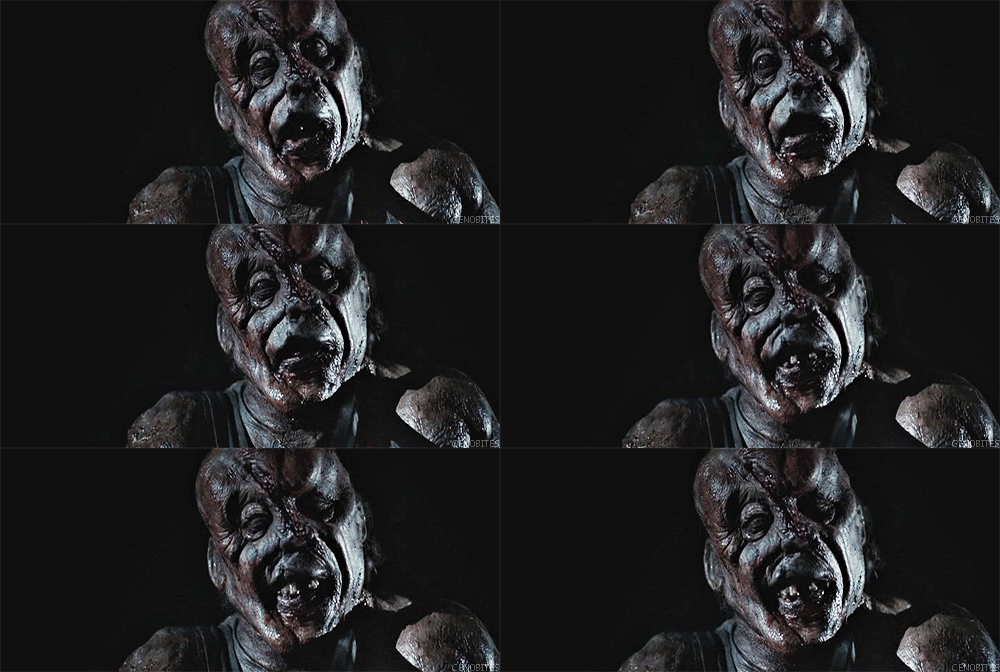
Review: Slasher films have definitely become a staple of horror films; where once it was all Gothic and nothing but atmospheric music and fog now comes visceral sprays of blood and gore in order to truly frighten a public that was too quickly becoming bored of the simplistic idea of 'less is more.' Of course, once you start going down the path of showing rather than telling, people become desensitized, and then things get ramped up past eleven so your audience feels something...and you see where this is going. Of course, not all slasher films are bad - in fact, Nightmare on Elm Street, Halloween, and Friday the 13th are all familiar faces (Freddy, Michael, and Jason, respectively) that every horror fan knows and loves. But its a very fine line in proving what makes a good slasher - generally the requirements are nothing more than a huge lumbering man who doesn't speak and either kills teenagers who drink and have sex or is just really pissed off for some inexplicable reason. And Victor Crowley fits that stereotype nicely.
There are lots of vampires these days. Lots of vampires trying new things, adding twists and attempting to be original. Mona of the puzzle RPG A Vampyre Story is not one of those vampires - and it's a good thing.
From the minds of the beloved Monkey Island series comes a rather stereotypical story; in my mind, so stereotypical that it's actually refreshing. Some people like trying new things, but for me, I'm a homebody, a slave to familiarity and things I know I like. A Vampyre Story takes everything from vampire mythology and has fun with it, presenting it in a fun, stylized fashion with interesting characters and dialogue. I mean, just look at the title. It's obviously an homage to John Polidori's The Vampyre, just looking at the spelling. The plot of the game is similar to many other horror stories as well - we have a young French opera singer who is captured by a fiendish if short vampire and taken to his castle in Draxsylvania. Young French opera singer? Sounds like Christine Daae from Phantom of the Opera. Draxsylvania? Why, what a clever twist on Dracula and Transylvania! And this is only the beginning of the dozens of references to both horror films, books, and other memorbilia as we follow the main character's story throughout the game.
Beyond just doing MWF updates here, I wanted to try doing something that would be unique to this particular blog - of course, on the Internet, there isn't much that particularly unique. Being a speshul snowflake is usually the one way to make yourself ripe for humiliation at the hands of millions, but I think I found something that both I and my readers can enjoy.
I call it Saturday Horror Shorts. I, Ash, will brave the wilds of YouTube (and other video hosting sites) in order to return with interesting, terrifying, or plain hilarious horror shorts that I can find for you, the reader, to enjoy. Like this idea? Well, if you don't, too bad, because this is what we're going with!
For the first installment of SHS, I want to introduce you to something I myself have found pretty recently through the FaceBook page for Creepy LA: the newly hatched webseries, Ask A Mortician! Now, you might be asking yourself, has no one done this before? Actually, there have been quite a few uploads of various aspects of the burial process, but nothing quite like this.
Mortician Caitlin Doughty takes and answers questions of all varieties in a comedic fashion. To paraphrase a comment posted by her on her YouTube channel, her hope is to familiarize viewers with the funeral process, thus making death seem not as terrifying as it's currently considered in our society. It's definitely a noble goal, one that I support wholeheartedly.
Here's Episode 4, by far my favorite episode:
Check out the other videos on her YouTube channel, Order Of The Good Death, and subscribe for updates! Hopefully next week's SHS won't be as wordy, but we'll just play this one by ear! Have a bloody awesome weekend!
As stated in a previous post, I adore all things Frankenstein. So when I found out about Pandora's Bride, I tried to find a copy in stores (which was futile). Recently I purchased a copy from Amazon - unfortunately, I didn't really find the book to be at the same level as other Frankenstein-esque titles I've read (Frankenstein's Monster, Frankenstein's Bride, The Casebook of Victor Frankenstein - which, to be fair, are all more recent titles, though not by much).
This is an officially sanctioned sequel to the Universal Studio's film The Bride of Frankenstein. For those who haven't seen the film, here's a spoiler alert - the Bride (played by Elsa Lanchester) is in the film for all of six minutes (and what glorious minutes they are!). The bulk of the film follows Dr. Pretorius as he slowly manipulates Henry Frankenstein into creating a female version of the creature. Though in the film Dr. Pretorius is supposed to be an evil man, I didn't quite find him to be so - after all, when no one else has taken pity on the creature (not even Henry, his creator), here is Pretorius, who steps up to give the creature something to help soothe his pain. Pretorius is found to be quite the mad scientist, having created several creatures already: all miniature in size, they vary from a king to a mermaid, each one more perfect than the last.
In the book, Pretorius continues his role of a gray-area benefactor to the female creature, who he adopts as a daughter of sorts. Perhaps in keeping with Shelley's original book, when the female creature is asked to pick a name for herself, she eventually settles on the greek Pandora, who is known for her curiosity and unwittingly releasing all of the horrors into the world; however, Pandora is described as a goddess of femininity (along with the more well known myth), which is what sways the female creature's decision. The story goes from Pandora's birthplace to the city of Berlin, with a wide cast that ranges from Pretorius' Children of Cain (the miniature creations he's made through various experiments, including a large horse that eats rodents), a narcoleptic named Cesare who acts as Pretorius' assistant, and another scientist named Rotwang who creates his beings out of mechanical parts. The villains of the piece turn out to be Henry and his wife Elizabeth, who are planning on remaking all females in the world into obedient slaves, through which they will control all men.
A theme of feminism is the most striking thing about the book, which is only natural since we're dealing with the creation of a woman solely for that of a mate (not unlike Eve in the Bible, but any Frankenstein-esque book is rarely without its religious themes) but it often comes off as heavy handed. I did enjoy having the main character be the bride herself, but I wish that she had shown the same amount of wit and inner turmoil that the creature exhibits in nearly every incarnation of Frankenstein that I've seen - instead she is of one mind, that she knows all, and if that's supposed to be a blatant statement about women, well, it's a poorly done one at that. Pandora bucks against expectations for her gender, but eventually comes to realize that one cannot be taken in by appearance and must learn from experience.
After reading Frankenstein's Monster by Susan O'Keefe, the writing definitely felt underpar; just as being sexually alluring is Dracula's trademark, the juxtaposition of an ugly exterior with a brilliant mind is Frankenstein's creature, and I simply didn't feel that level of intelligence coming through in the writing. I do enjoy the fact that the creature got a voice this time around (it's essential to his character, and being stripped of it in the film really destroys his evolution as put forth in the original book), and that he is also given a chance to prove himself to earn Pandora's affection; but honestly, the book doesn't do much that's new. It was also an incredibly quick read - I literally sat down and was done with it in the same day. I certainly wouldn't reccommend this book to a Frankenstein purist, either of the Universal Movies flavor or the book; I'm a little sick myself of seeing Henry/Victor being shoehorned into the villain role. I would tell anyone interested in this book to pass on it.






_001.jpg)